
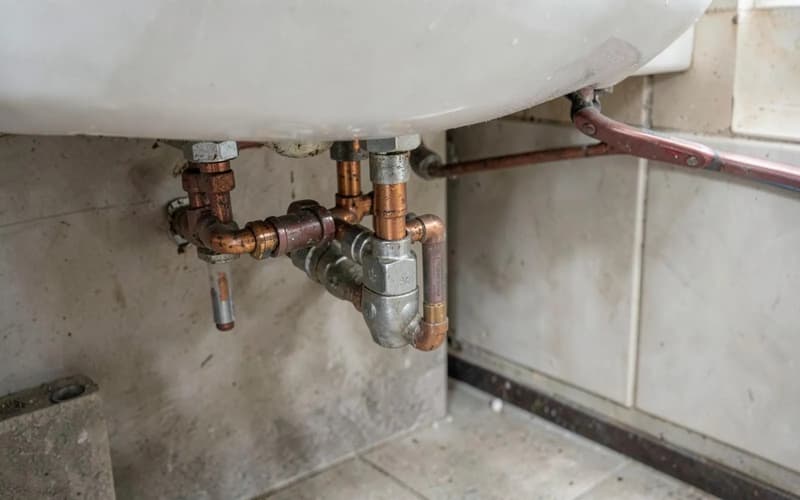
Problem guide
Burst or leaking pipe: what to do first
Written by Robert, DK Construction Ltd
Last updated:
A burst pipe can release a startling amount of water in a very short time, and even a slow leaking pipe quietly soaks floors and ceilings for weeks. The first steps are the same in both cases: stop the water, protect what you can, and get the fault found properly rather than patched and forgotten.
The first five minutes
Turn off the stopcock. In most homes it is under the kitchen sink, in a downstairs cupboard or where the water main enters the property, and turning it clockwise stops the supply to the whole house. It is worth finding yours today, before you ever need it in the dark.
Then open the cold taps to drain the water sitting in the pipes, which reduces what is left to escape. If water is near sockets, switches or light fittings, switch off the electricity at the consumer unit for the affected area, and keep people clear of any ceiling that is bulging with water. Move furniture, rugs and electronics away from the wet area and catch drips in buckets.
A burst pipe or a slow leak?
A burst pipe announces itself: water pouring or spraying, a rapidly growing stain, a ceiling dripping in several places. A slow leak is quieter: a stain that grows over days, a musty smell, a floor that feels spongy near a wall, or a meter that moves when nothing is running. Slow leaks cause just as much damage, but over months rather than minutes.
The repair approach differs too. A burst needs the water off and the section replaced. A slow leak needs finding first, because the visible stain is often some distance from the failed joint. Our leak detection page explains how hidden leaks are traced.
Why pipes burst
Freezing is the classic cause: water expands as it freezes, and an unlagged pipe in a loft, garage or outside wall can split over a cold snap, with the flood only appearing when it thaws. Beyond freezing, pipes fail at corroded joints, at flexible connectors to taps and appliances that perish with age, and where a pipe has been accidentally nailed or screwed through during other work.
After any burst, it is worth asking why. Lagging exposed pipework, replacing ageing flexible hoses and fitting isolation valves are all cheap ways to avoid a repeat.
How the repair works
First the water is isolated and the failed section exposed. A burst on an accessible pipe is usually a cut-and-replace repair: the damaged section comes out and a new piece is jointed in, then the system is refilled and tested. A pipe inside a wall or under a floor needs opening up to reach, and we agree where before doing it.
Once the pipe is sound, attention turns to what the water damaged. Because our team covers plastering and decorating as well as plumbing, the ceiling or wall can be dried, reboarded and redecorated by the same people, which avoids the usual gap between the plumber leaving and the making good starting. Our guide on what to do first in a plumbing emergency covers the safety steps in more detail.
Need it sorted? Book an emergency plumber
If water is escaping now, our 24/7 call outs cover Essex, Kent and East London: we stop the water, make the property safe and explain the permanent repair. For slower leaks, book a visit through the quote form and we will trace the source properly. Quotes are free, and the repair carries our 1-year workmanship warranty.
Frequently asked questions
How do I know if there is a burst pipe in my area?
Signs of a mains burst in the street include a sudden loss of pressure or discoloured water across several homes; your water company tracks those. Inside your property, a burst shows as escaping water, a fast-growing stain or a meter spinning with everything off.
How much does it cost to fix a burst pipe?
It depends on where the pipe is and what the water has damaged. Replacing a section of accessible pipe is the simplest case; pipes inside walls or floors need opening up and making good, and water damage to ceilings and floors adds to the work. We quote before starting.
Will a small leak get worse if I leave it?
Almost always. A weeping joint does not heal itself, and the water it releases soaks timber, plasterboard and insulation, turning a simple pipe repair into floor or ceiling work as well.
Should I turn the water off for a slow leak?
If you can see where it is coming from and it is contained, isolating that section or fixture is enough. If you cannot find it or water is spreading, turn off the stopcock and book a visit.
Do you repair the damage after the pipe is fixed?
Yes. The same team can dry out, reboard, plaster and redecorate the affected area once the pipework is sound.
Services related to this problem
Related guides
Prefer to talk it through first?
Free quotes, clear pricing and a 1-year workmanship warranty.
Free, no obligation
Get your free quote
Tell us about the property and the work you need. Robert will come back to you with honest advice and a clear price.