
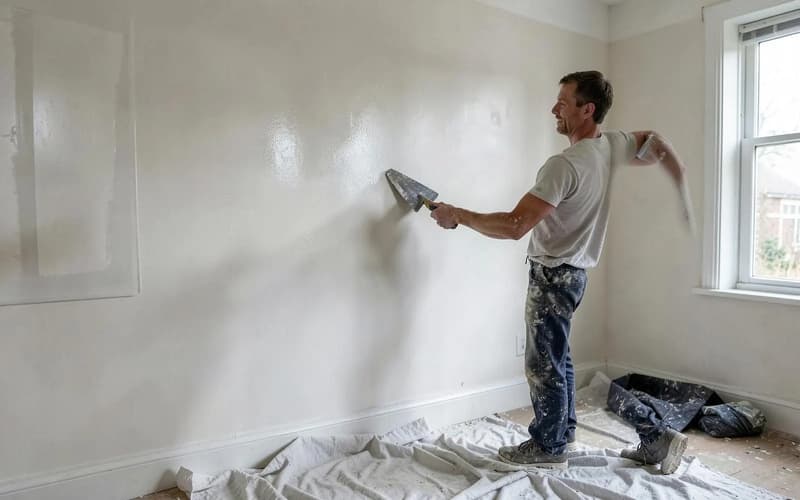
Plastering
Plasterer Gravesend
A plasterer Gravesend enquiry can distinguish King's Farm's mainly 1920s development from post-war estates and rebuilt Christianfields while keeping the actual wall condition central. These growth phases do not establish original plaster or a standard repair method. DK Construction Ltd's existing Kent plastering service covers local repairs, preparation and finishing discussions. Identify retained details, visible defects and any known alterations before deciding whether patching, skimming or more extensive work suits the room.
Growth phases without a nineteenth-century assumption
Gravesend grew south and east from the riverside landing, with King's Farm mainly developed in the 1920s after the First World War. Many surrounding estates were built after the Second World War, and Christianfields was rebuilt. That is not evidence that every town-centre wall is nineteenth-century or every later wall has the same backing. Show the surfaces and known changes within your property.
The Royal Terrace Pier and Town Pier are Grade II listed riverfront landmarks; the remains of a 1543 Henrician device fort and New Tavern Fort add to the town's heritage. They do not establish listed status for nearby homes. Where your building or retained fabric is protected, check the particular requirements with Gravesham Borough Council before alteration. Photograph the junctions around coving, trim and planned repair edges.
Decide whether the background is still useful
Flaking paint, detached plaster and an uneven but stable surface represent different starting points. Describe the observable condition and earlier repair history without disturbing loose or suspect material yourself. A fine finishing layer should not be used as an explanation for why failed backing can remain. The scope follows the surface assessment, not simply the desired smooth appearance.
Our plastering page covers repairs, skimming and related preparation. In a Gravesend terrace, note adjoining rooms and any earlier service openings. A crack that returns after filling should be identified as recurring rather than treated as a fresh cosmetic mark with no history. That distinction can affect what needs investigating before finishing.
Borough housing mix and service-opening boundaries
Across Gravesham, Census 2021 recorded 16.4% detached homes, 33.1% semi-detached, 30.0% terraced and 20.3% flats. These shares cover the local authority, not Gravesend town alone. They cannot specify a substrate, but they remind an enquiry to identify the actual dwelling and access. A flat's shared route and a house's occupied hallway need their own arrangements.
An opening for plumbing or a removed fitting should be described with its surrounding finish and any checks still outstanding. Do not agree to close access that the service work still needs. Distinguish an isolated damaged corner from wider detachment or recurring cracks. The desired smooth finish cannot establish that the background is sound, nor should visible instability be concealed beneath a general skim request.
Moisture history before a new finish
A stain in a room below a bathroom can outlast the leak that caused it. Explain when water was seen, what has been repaired and whether the patch continues to change. Wet or weakened backgrounds may need assessment and drying before plaster work. Fresh decoration alone does not establish that a source of damp has been resolved.
With old textured coatings, seek accredited assessment and testing before any disturbance, ensuring UKAS scope covers the survey and laboratory analysis. Do not scrape or sample material yourself. Skimming and overboarding are not automatically safe approaches to suspect coatings, and no asbestos removal capability is claimed on this page. Keep the coating separate from ordinary untextured repairs in the brief.
Retain character without leaving scope unclear
The Gravesend area hub connects plumbing, decoration and other related work. Use the quote form with room photographs, the postcode and a list of retained features. Say whether this is a local repair, several damaged areas or preparation for complete redecoration. Include furniture and access constraints for an occupied house. Discuss the drying and finishing sequence around the actual materials rather than assuming older walls can be repaired and painted on an arbitrary deadline.
Frequently asked questions
Does a King’s Farm address prove the plaster is from the 1920s?
No. The area’s mainly 1920s growth is context; later alterations can change individual walls. Describe known repairs and the visible backing without inferring a material or method from the address.
Do the listed riverfront piers make neighbouring homes listed?
No. Royal Terrace Pier and Town Pier are Grade II listed, but private buildings need their own status checked with Gravesham Borough Council before protected fabric is altered.
Are the 30.0% terraced and 20.3% flats shares town-only figures?
No. They are across Gravesham at Census 2021. Identify your actual dwelling, access and substrate rather than using borough percentages to choose a plastering method.
Can an old service opening be closed before the repair is checked?
Clarify that the service work and required checks are complete first. Retained access, moisture concerns and any suspect textured coatings need their appropriate assessment before finishing.
Related pages
Discuss your Gravesend repair list
Free quotes, clear pricing and a 1-year workmanship warranty.
Free, no obligation
Get your free quote
Tell us about the property and the work you need. Robert will come back to you with honest advice and a clear price.