
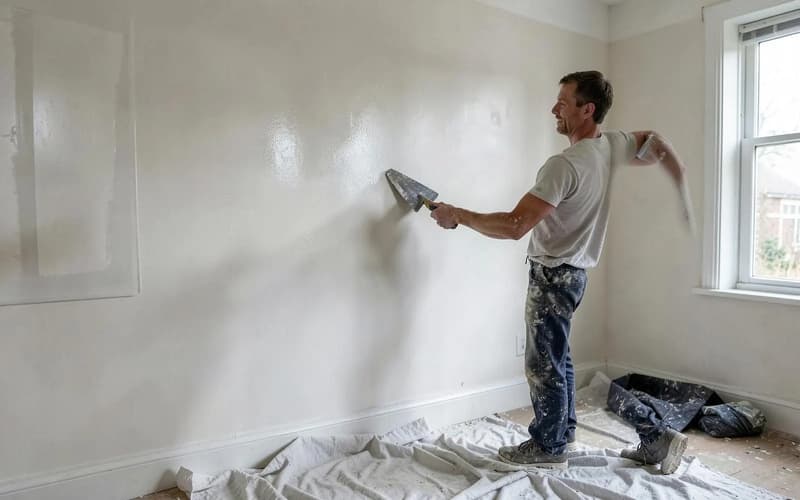
Plastering
Plasterer Dartford
Dartford's Town Centre conservation area and Temple Hill estate, begun in 1947, give a plasterer Dartford enquiry two different starting points. Retained features, later service openings and the condition of existing surfaces deserve attention before selecting a finish. This is a Kent town under Dartford Borough Council, not a London borough. DK Construction Ltd's existing plastering service covers the repair discussion without assuming a building's date identifies the plaster behind its paint.
Conserved centre, post-war estate and apartment finishes
The Dartford Town Centre conservation area gives retained details a place in the repair brief. Temple Hill's 1947 estate and the later Langley Square apartments on the former GSK site represent different building histories, but none establishes what a particular ceiling contains. Across Dartford, Census 2021 recorded 30.9% terraced homes and 24.2% flats, local-authority figures rather than counts for the town centre. In a flat, identify any shared construction and authorisation before defining an opening's reinstatement. For a retained interior, photograph the details that should survive the repair.
Photographs should show the damaged area in relation to the complete wall. Note nearby sockets, pipes, door frames and retained finishes. Do not open additional areas or disturb suspect material to demonstrate the backing. Accessible information is enough to explain what has changed and which details still require assessment.
Making good follows a completed service brief
Before an opening is closed, clarify whether the connected trade has finished and whether access must remain. Pipe boxing, valves and other serviceable components may need continued reach. The desired uninterrupted wall should be considered alongside those practical requirements rather than assuming that a new plaster surface can cover every opening.
Describe who is responsible for the service work and any checks, but do not treat a plastering enquiry as authorisation for regulated gas or electrical tasks. Our plastering service covers the finish and repair discussion. A clearly identified opening and agreed access arrangement make that scope easier to understand than a request to tidy up after unspecified building work.
A patch is not a complete wall finish
Local making good may leave a transition beside existing texture or coatings. Explain whether the aim is repair only, preparation for an entire wall to be painted or a consistent new finish across the room. Light from a window can reveal changes that are less visible straight on, so the expected appearance should be part of the brief.
Damaged plasterboard can require attention to the support and joints, not just filling its face. Similarly, loose backing around an opening may extend beyond its visible edge. Give approximate dimensions and mention whether the problem has widened. Do not assume a thin finishing coat can stabilise material that is no longer secure.
Keep leak damage outside simple snagging
A recent home can still have water-damaged plaster or a disturbed ceiling. Explain any leak source and the repair already completed, and distinguish dry discolouration from material that remains wet or weak. Active water escape needs its own contact and repair discussion. Making good belongs after the source and affected construction have been appropriately considered.
If a ceiling has a suspect textured coating, accredited assessment and testing come before disturbance, with UKAS scope covering the survey and laboratory analysis. Do not attempt scraping or sampling. Overboarding or skimming is not automatically safe, and this page does not offer asbestos removal. Sagging or unstable ceiling areas also need assessment rather than being folded into an ordinary decorative patch list.
Coordinate the room and the finish
The Dartford area hub links the broader maintenance services. Submit the postcode, photographs and the completed service-work details through the quote form. Specify what remains exposed, which fittings are retained and the proposed decoration after repair. Include apartment access rules or occupied-room constraints. Plaster drying and coating readiness depend on conditions, so an intended decoration date should be discussed rather than assumed to determine when the repaired wall is ready.
Frequently asked questions
What should I record for plaster repairs in Dartford Town Centre conservation area?
Identify retained details and the precise work proposed, and include any relevant advice from Dartford Borough Council. Conservation status is not a reason to assume removal is acceptable or that every internal repair has the same consent requirements.
Does a Temple Hill ceiling necessarily date from 1947?
No. The estate began in 1947, but later replacements and alterations may have changed a room. Record known repair history and visible condition rather than assigning a material solely from the estate's age.
What information helps after plumbing access in a Langley Square flat?
Give the apartment access arrangements, the opening dimensions and whether the water fault has been resolved. Confirm any access that must remain before a service route is closed, and identify the wall or ceiling finish expected after repair.
Should a northern-marsh flood-damaged wall be skimmed straight away?
No. The source, moisture condition and suitability of the affected construction need assessment first. Flood resilience may warrant separate advice in flood-zone streets; a fresh plaster finish is not a substitute for understanding water damage.
Related pages
Discuss your Dartford repair list
Free quotes, clear pricing and a 1-year workmanship warranty.
Free, no obligation
Get your free quote
Tell us about the property and the work you need. Robert will come back to you with honest advice and a clear price.