
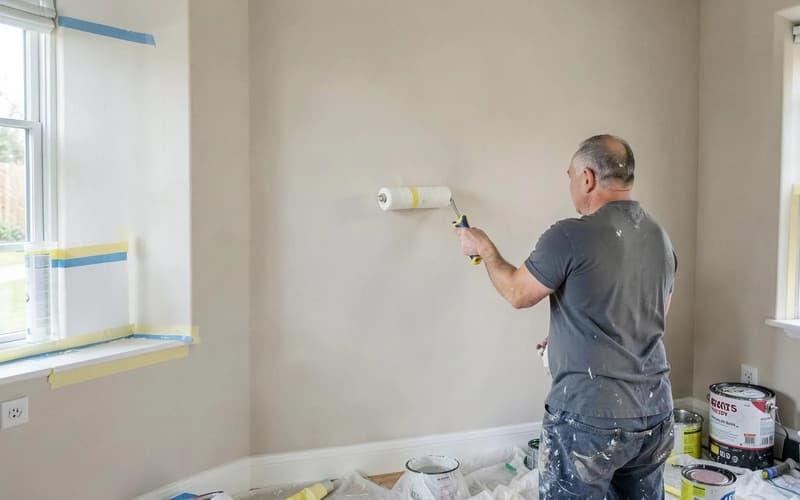
Decorating
Painters Basildon
Painters Basildon enquiries can start by separating retained finishes in plotland-era homes from later surfaces in the new-town neighbourhoods. Farms were sold for development in the 1920s and 1930s before the 1949 new-town designation. That history does not identify today's coating, while heavy clay ground is context rather than proof of a crack's cause. DK Construction Ltd's existing decorating service considers preparation, surface boundaries and access for the actual rooms.
Retained coatings across two development eras
Basildon's plotland origins preceded the 1951 new-town masterplan, with small neighbourhoods and employment along the A127. Houses built from the 1950s and 1960s onwards may now contain several generations of paint, paper and alteration. A development date cannot establish that a finish is original or that every room needs identical preparation. Photograph retained coatings, repaired junctions and woodwork from the particular property.
If earlier work has changed a doorway or connected two rooms, mark where the new colour should stop. Returns, reveals and the underside of stairs can be missed in a room-only description. Later patches should be identified separately from sound retained surfaces so the decorative brief explains both preparation and the intended finish.
Choose priorities for a lived-in house
Identify the rooms with essential access and those that can be cleared more readily. A landing may serve every bedroom, while a spare room can provide temporary storage. Say what furniture remains and whether wall-mounted items will be removed. These details allow access to be discussed without an assumption that the house becomes empty when decoration is requested.
Keep the specification of each surface visible: walls, ceiling, doors and skirtings need not share the same scope. A request to paint downstairs is ambiguous about cupboards, stair strings and the underside of a staircase. The Basildon hub gives the wider property context; this page concentrates on finishing the named surfaces rather than a whole-home renovation.
Recurring marks before colour and sheen
The area has heavy clay soil, formerly poor-quality farmland. A returning crack should not automatically be attributed to that ground, nor labelled harmless because the house is in a new-town neighbourhood. Give its history, any known movement, repairs or water problems. Appropriate assessment may be needed before decorating; paint cannot resolve instability or moisture by covering the visible mark.
Across Basildon borough, Census 2021 recorded 18.6% flats and 32.6% terraced homes, alongside 26.5% semi-detached and 21.8% detached. These figures also include Billericay and Wickford and do not describe a single room's construction or access. The decorating hub sets out the existing service; specify surfaces, retained coatings and unresolved defects independently of the borough housing mix.
Use a consistent room-by-room enquiry
Photograph each room with its doors and main windows visible, then add close views of particular defects. Identify retained colours and the areas where a change is intended. If matching existing paint matters, include any reliable product reference, recognising that ageing and previous application can affect appearance. A local touch-up and a complete wall finish should remain different instructions.
Use the quote form with the postcode, room priorities, occupancy details and scope for woodwork. Where a leak or substantial plaster defect remains unresolved, put it on a separate repair line. A clear decorating brief helps discuss preparation and access without adding prices, guaranteed dates or assumptions about the condition of every Basildon home.
Frequently asked questions
Should a crack in a Basildon room be blamed on clay soil before painting?
No. Heavy clay is local context, not proof of the cause. Give the history and arrange appropriate assessment where movement or instability is suspected; a coating cannot remedy the underlying issue.
Does a plotland-era home necessarily retain its first paint layers?
No. The 1920s and 1930s development history does not establish the current coating. Identify known changes, retained paper or timber finishes and the condition of each surface.
How do I define decorative edges after a new-town room has been altered?
Show the present openings and junctions, with the intended colour stopping points marked. Development-era labels do not reveal where earlier rooms or later extensions meet.
Do the borough’s 18.6% flats establish my access arrangements?
No. That share is across Basildon borough, including separate towns. State your actual floor, shared routes, occupied rooms and any building rules in the decorating enquiry.
Related pages
Discuss your Basildon property
Free quotes, clear pricing and a 1-year workmanship warranty.
Free, no obligation
Get your free quote
Tell us about the property and the work you need. Robert will come back to you with honest advice and a clear price.